
Art made by Artificial Intelligence has been prevalent in the news recently. An exhibition at the LACMA examines the origins of art made with computers, and the events that led to the relevance of the personal computer.

By Amandine Galama – 10th grade.
The exhibition Coded: Art Enters the Computer Age, 1952–1982 explores the rise of computers in art and culture during the mid 20th century. Open till July 2nd, Coded, chronicles the influence of computers on art, beginning in 1952, the year of the first purely aesthetic image made with a computer, and ending in 1982, the year personal computers replaced the mainframe, and a year before the release of the film WarGames.
When mainframe computers first appeared in the 1940s, they were used for military purposes. These computers were huge, and got their name from the large cabinet, or main frame, that was home to the central processing unit and memory. While according to today’s standards their capacity seems minimal, at the time this was very innovative technology. The computer soon began to enter into the popular consciousness through media, starting in the post-war years. Some depictions of this new technology portrayed it as “an all-powerful ‘electric brain’”, an idea largely influenced by notions of cybernetics, as well as UNIVAC’s (Universal Automatic Computer) accurate prediction of Dwight D. Eisenhower’s landslide victory in the 1952 presidential election. The mainframe also however, represented progress and innovation, thanks to its association with NASA, and ability to steer spacecrafts into orbit, and eventually land them on the moon.
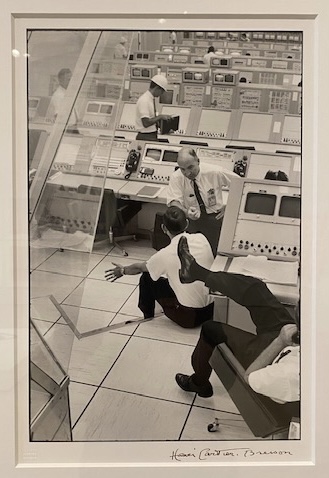
The first moon landing in 1969 was a major historic event, and some of the artwork in the exhibit reflects on this. Lowell Nesbitt’s painting, Firing Room, can be seen in the exhibition, as well as a photo of JFK Space Center by famous French photographer Henri Cartier-Bresson. In a time of increased political and social awareness, thanks to the civil rights movement, anti-Vietnam War sentiment, and the feminist movement, the computer served as an important political tool. While to some, the computer caused ambivalence due to its association with the military, others used it as a tool to express their political beliefs.
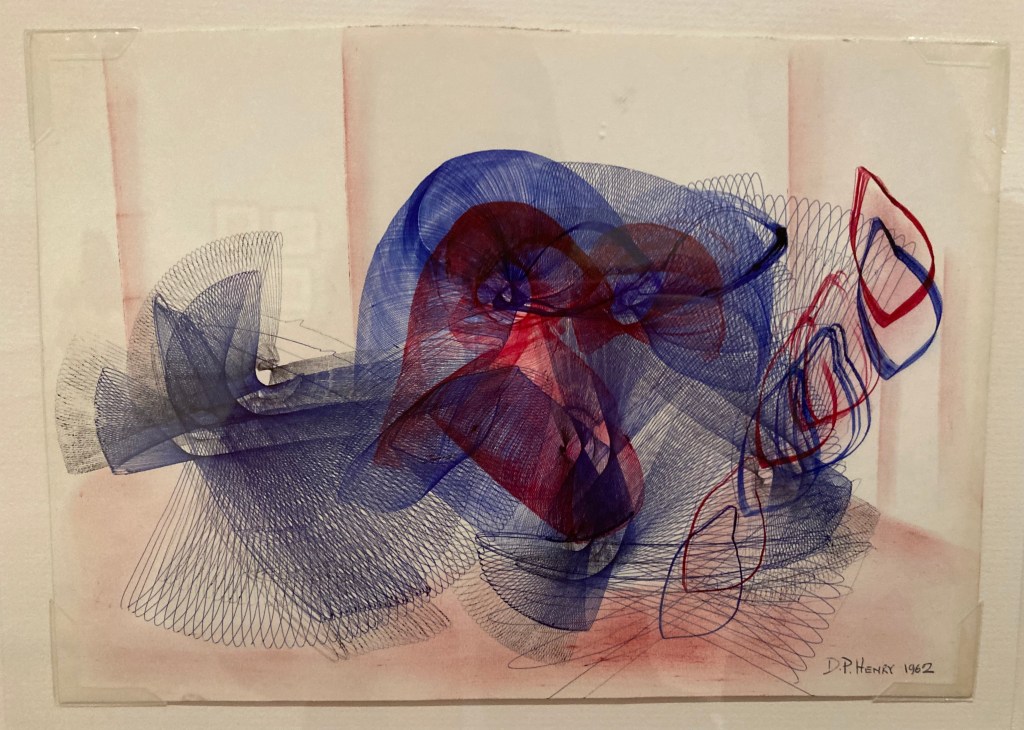
Many artists used mathematical systems to create their art. Various shapes, such as circles, spheres, squares, cubes, and other mathematical curves characterized much of early computer art, because these were programmable at the time. The most common computer programming language was FORTRAN. Artist Desmond Paul Henry made art with modified bombsight analog computers used in World War II. His mechanical drawings were made with ballpoint pens, and were always varied and made by chance.
While computer art was a new and innovative form of art, many artists using this new medium were still influenced by artists from the past. The work of modern artists such as Piet Mondrian and Paul Klee lended well to programming, since their art was mostly composed of shapes. Many early computer artists were inspired by their works, and the similarities to their form of art helped give legitimacy to this new form of art. Artist Hiroshi Kawano, for example, made his artwork thanks to a probability matrix in order to generate a grid, which once printed would be painted by hand, and resembled Mondrian’s artwork.
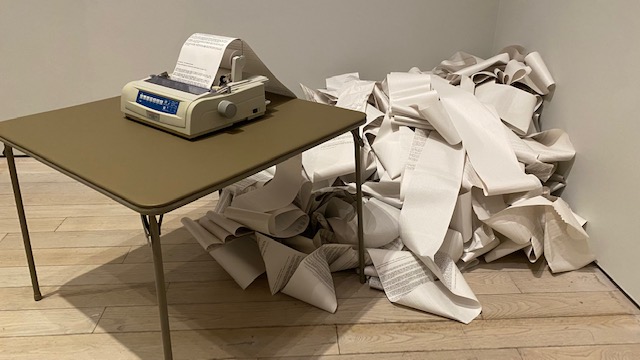
My personal favorite artwork in the exhibition was News, by German artist, Hans Haacke. This work is a printer that prints current articles from select English-Language media outlets. The paper then builds up to symbolize “information overload”. While I was visiting, an article from The Guardian was being printed.
There is not only visual art in the exhibition. At the entrance, it is possible to scan a QR code, which gives the link to a soundtrack by Mark “Frosty” McNeill and LACMA, which allows visitors to also hear the evolution of computer music, while they tour the exhibition. The soundtrack is 58 minutes long, presumably how long it takes to go through the exhibit, so be sure to bring headphones in order to not miss out!

Ever since its creation, the computer has been culturally influential, and continues to be so as technology evolves. Today computers, and in particular Artificial Intelligence, continue to cause controversy, as some view its artistic potential positively, while others fear the impact it may have on intellectual property and the loss of authenticity.
Art in the Age of the Computer
Art made by Artificial Intelligence has been prevalent in the news recently. An exhibition at the LACMA examines the origins of art made with computers, and the events that led to the relevance of the personal computer.
The exhibition Coded: Art Enters the Computer Age, 1952–1982 explores the rise of computers in art and culture during the mid 20th century. Open till July 2nd, Coded, chronicles the influence of computers on art, beginning in 1952, the year of the first purely aesthetic image made with a computer, and ending in 1982, the year personal computers replaced the mainframe, and a year before the release of the film WarGames.
When mainframe computers first appeared in the 1940s, they were used for military purposes. These computers were huge, and got their name from the large cabinet, or main frame, that was home to the central processing unit and memory. While according to today’s standards their capacity seems minimal, at the time this was very innovative technology. The computer soon began to enter into the popular consciousness through media, starting in the post-war years. Some depictions of this new technology portrayed it as “an all-powerful ‘electric brain’”, an idea largely influenced by notions of cybernetics, as well as UNIVAC’s (Universal Automatic Computer) accurate prediction of Dwight D. Eisenhower’s landslide victory in the 1952 presidential election. The mainframe also however, represented progress and innovation, thanks to its association with NASA, and ability to steer spacecrafts into orbit, and eventually land them on the moon.
The first moon landing in 1969 was a major historic event, and some of the artwork in the exhibit reflects on this. Lowell Nesbitt’s painting, Firing Room, can be seen in the exhibition, as well as a photo of JFK Space Center by famous French photographer Henri Cartier-Bresson. In a time of increased political and social awareness, thanks to the civil rights movement, anti-Vietnam War sentiment, and the feminist movement, the computer served as an important political tool. While to some, the computer caused ambivalence due to its association with the military, others used it as a tool to express their political beliefs.
Many artists used mathematical systems to create their art. Various shapes, such as circles, spheres, squares, cubes, and other mathematical curves characterized much of early computer art, because these were programmable at the time. The most common computer programming language was FORTRAN. Artist Desmond Paul Henry made art with modified bombsight analog computers used in World War II. His mechanical drawings were made with ballpoint pens, and were always varied and made by chance.
While computer art was a new and innovative form of art, many artists using this new medium were still influenced by artists from the past. The work of modern artists such as Piet Mondrian and Paul Klee lended well to programming, since their art was mostly composed of shapes. Many early computer artists were inspired by their works, and the similarities to their form of art helped give legitimacy to this new form of art. Artist Hiroshi Kawano, for example, made his artwork thanks to a probability matrix in order to generate a grid, which once printed would be painted by hand, and resembled Mondrian’s artwork.
My personal favorite artwork in the exhibition was News, by German artist, Hans Haacke. This work is a printer that prints current articles from select English-Language media outlets. The paper then builds up to symbolize “information overload”. While I was visiting, an article from The Guardian was being printed.
There is not only visual art in the exhibition. At the entrance, it is possible to scan a QR code, which gives the link to a soundtrack by Mark “Frosty” McNeill and LACMA, which allows visitors to also hear the evolution of computer music, while they tour the exhibition. The soundtrack is 58 minutes long, presumably how long it takes to go through the exhibit, so be sure to bring headphones in order to not miss out!
Ever since its creation, the computer has been culturally influential, and continues to be so as technology evolves. Today computers, and in particular Artificial Intelligence, continue to cause controversy, as some view its artistic potential positively, while others fear the impact it may have on intellectual property and the loss of authenticity.


 lilagazette.com
Leave a comment