
The famous episode in the Bible might have actually happened in real life. The ten plagues that brought Egypt to its knees might have just been natural disasters.
By Eden Perkins – 9th grade.
Picture this: Moses yells as he touches his staff to the ocean. The water turns into blood. This is the first of the Ten Plagues of Egypt. Around 3,000 years ago, when Pharaoh Ramses II enslaved the Isrealites, Moses, a Hebrew prophet, casted ten plagues on Egypt when the Pharaoh refused to let them go, hence the famous line: “Let my People go.” Those ten plagues were, in order: all the water turning into blood, a rain of frogs, lice, wild animals, a virus killing all the livestock, boils on egyptians, a fiery hail, locusts that eat all the crops, complete darkness on the land (except for the israelites houses), and finally, the killing of the firstborn son in all the egyptian families. These are horrible to imagine. Were they just myths, or natural events that actually happened?
The First Plague is all the water in Egypt, the Red sea, the Nile, even water poured into cups, turning simultaneously into blood. Scientists have explained how this could have happened. There is a certain kind of algae called Oscillatoria rubescens, that, with certain weather conditions, can bloom extremely quickly. It is a very toxic type of algae. With this algae in it, water takes the appearance of blood. It is known to have existed over 3,000 years ago, at the time of the Ten Plagues. That would explain both why people thought the water was blood and why it was toxic and undrinkable.
The Second Plague is a rain of frogs. These amphibians found their way into the houses of the Egyptians, and ruined their meals, beds, and more. First of all, the algae could have set the other plagues (frogs, lice, flies) in motion. The toxic algae would have forced all of the frogs out of their natural environment and onto land. But the Bible talks about the frogs falling from the sky. The most plausible scenario is a type of tornado called a “waterspout” when formed above water. It is very likely that it took the very light frogs from another river and transported them to Egypt via the Nile. Then, the waterspout dropped the frogs. This has been reported many times throughout history, even recently!
The Third Plague is lice. However, historians are not sure of the exact insect. The Hebrew word “Keenim” can mean lice, fleas, or gnats. Since this is ancient and not modern Hebrew, it is even harder to decipher. The explanation for this is simple: the frogs that were brought to Egypt or that were already in Egypt died at one point. Whenever a rotting corpse is somewhere, there are usually insects hovering around it. And, without frogs to be the predators, the population of insects would increase drastically. In a National Geographic television program, climatologist Stephan Pflugmacher explained that both lice and fleas carry and transmit the Yersinia pestis bacteria, which causes the bubonic plague. That might be interesting later on.
The Fourth Plague is also difficult to explain. The Hebrew word “arov” can be translated as wild beasts, hornets, mosquitos, or even wolf-like entities. For the sake of simplicity, wild animals are the examples most commonly used. However, in a study published in 1996 by J.S. Marr and C.D. Malloy, the fourth plague is interpreted as a swarm of flies. The bites from these insects could have led to the boils later.
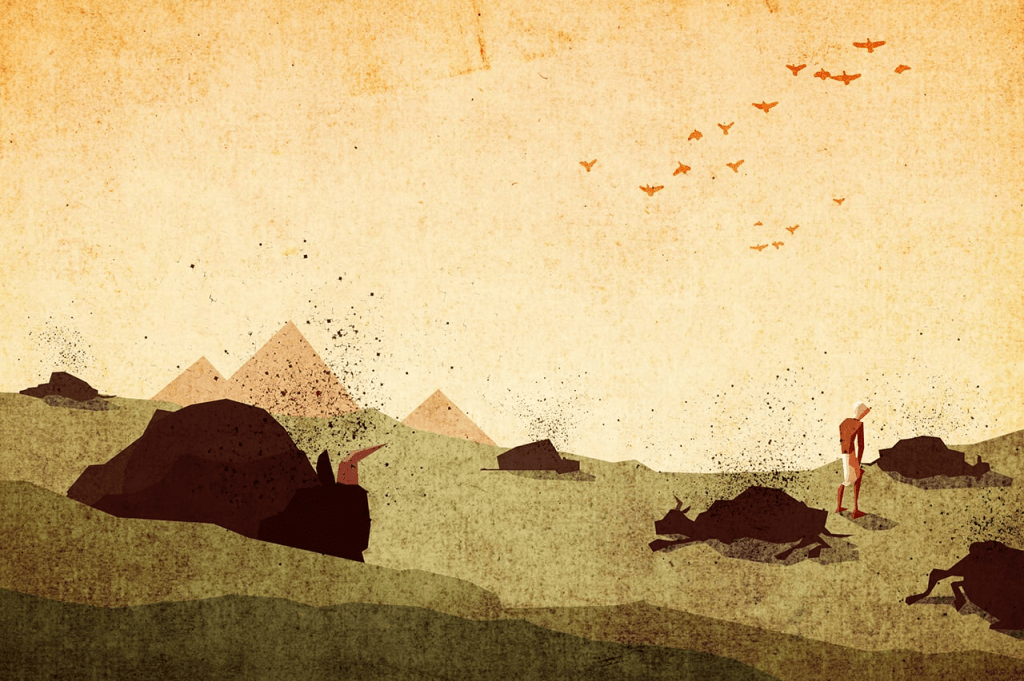
The Fifth Plague is a mysterious virus that kills all of the livestock in Egypt extremely quickly. This is incredibly simple to explain because the exact same thing happened in Europe from the 18th through the 19th century. It is called Rinderpest (Rinderpest morbillivirus). The symptoms of Rinderpest in animals are: Discharge (yellow-green pus) coming from the animal’s eyes and diarrhea leading to death. It could have been in Egypt during the time of the plagues. And, with the other bacteria circulated in that time, it could have easily spread to the livestock. In 2011, Rinderpest was officially eradicated. Hundreds of millions of animals have been estimated to have been killed by this virus in the 18th and 19th century, according to the World Organisation for Animal Health.
The Sixth Plague is painful and bloody boils. There are three possibilities for this. It could have been the Yersinia pestis (the Bubonic Plague that decimated Europe in the 14th century), or the bites from the fly swarm during the Fourth Plague. Although, it could have also been smallpox. Mummies have been found with smallpox scars (some of them even pharaohs), leading to the conclusion that the Sixth Plague was smallpox. Since there were no vaccines back then, this is a viable option.

The Seventh Plague is fiery hail. The main possibility is that it could have been a huge volcano eruption, sending ash and lava into the sky. It is known that there was a volcano in Santorini, which is an island north of Crete in the Aegean Sea (in the Mediterranean Sea). There is evidence that this volcano erupted around 3,000 years ago, at the time of the plagues. This volcano, now called Santorini Caldera, is still considered active, and its last eruption was on February 2nd, 1950.
The Eighth Plague was a giant swarm of locusts that ate all of the crops. This has happened many times in history. In 1931 (in Nebraska and areas near it), there were so many locusts that it was said that they “blocked out the sun and one could shovel the grasshoppers with a scoop” as said by History.com. In addition, the explosion from Santorini Caldera probably made ideal weather conditions for the locusts to come into Egypt. The locusts could have very likely eaten all the crops and then caused a lot of starvation.
The Ninth Plague was complete darkness being forced on the land for three days. This could have been a mix of the ashes from the volcano and the locusts leaving. In the 1931 locust plague, after the locusts finished eating, they all left in waves, and this blocked out the sun for days on end. This is probably what happened because there are actual records of this happening in history. There are photos and videos of the locusts in 1931 blocking out the sun and casting darkness on the land.
The Tenth and final plague was the killing of the firstborn son of all Egyptians.The most plausible explanation is as follows: the firstborn son of Egyptians was the first to pick the grain. The toxic particles that the algae created could have gone into the air and into the grain. The firstborn would have picked it, and then died from the toxins. The Israelites, however, didn’t have grain to pick due to their extreme poverty in Ancient Egypt, so they were safe. This is very likely that it happened. It also provides a perfect explanation of why the Israelites didn’t die. However, that still doesn’t explain the goats’ blood on the doors as told in the Bible.


 lilagazette.com
Leave a comment