
In an interview with LILA Gazette’s Eden Perkins, as the school celebrates its 45th anniversary, M. Maniska recounts the fascinating history of LILA as well as plans for this competitive new century.

By Eden Perkins – 9th grade.
Where was the first LILA and how different was the program from today?
The school was founded in 1978 in the Los Angeles suburb of Van Nuys.
Four founding parents started the school called the Collège d’Études Françaises- CEF. And it had 7 students of whom five were the children of the founders.
The founders were two remarkable women and their husbands, but it was really the women who founded LILA. Monique Mickus, who was the founding Head of School, was the pedagogical brainchild and Pierrette Gaspart was the operational person. Monique Mickus sadly passed a number of years ago, she was Head of School right up until her passing. Pierrette retired during the pandemic, and we had lots of conversations about what it was like in those early days.
What grades did it teach back then?
The school started as an elementary school, but quickly, I’m imagining that the elementary school had some upper elementary kids, and then offered continuity to those students. But the school wasn’t originally accredited. I believe they were given French government accreditation in 1983.
Was it free or was there tuition?
Because it was a private school, LILA has always had tuition fees.
Did the original teachers, including the founders, have degrees or did they just want to teach?
I believe Mme. Gaspart was a translator and she had qualifications as an administrator. The grandfather of Mme. Mickus was one of the founders of the Mission Laïque Française. So they came from a long line of educators.
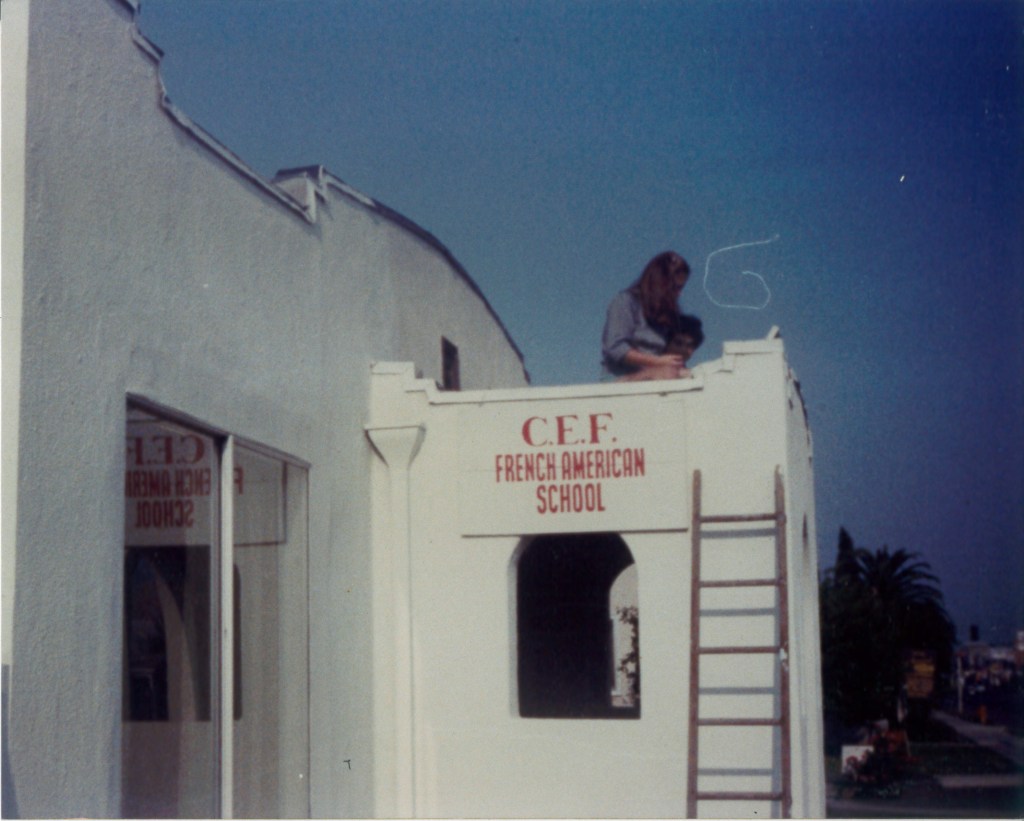
In the original LILA, was it only kids that spoke French or did they teach French?
There was a small ad that said: “French-American School” was “recruiting.” They ran ads to bring students into the school’s unique bilingual program. My understanding, though, was that bilingual programs were not technically recognized in California in those days. So there were a few years, before they got their French accreditation, where it was really people who just believed in the vision and who wanted an immersion program in English and French. You have to also think about LILA in terms of where the world was at in 1978. Words like “globalization” were not in our vocabulary. I’m talking also about terms such as internationally minded and global citizenship, those expressions were not commonplace, so our founders were true visionaries. They wanted the best of the French academic system, on the one hand, but in an international and English-speaking setting.
When was the IB program added to LILA?
French accreditation happened in 1983. WASC (Western Association of School and Colleges) happened in 1992. IB accreditation happened in 1997. The first IB class was the class of 1999. The graduating class in 1999 was 6 students. 3 did the Bac and 3 did the IB.
Did they always have delegates in the classes when the school grew or when was that added for student councils?
The Burbank campus is now in its 11th year, and before Burbank, all the students were at Los Feliz. And there was a slim track that went to the Bac, but it was quite a small Collège and Lycée. So a lot of the work around student council, that all started really in earnest when this [Burbank] campus opened. They still have Conseil de Classe and they got Délégués de Classe in the elementary, but a lot of the leadership as you would know it today would be initiatives that happened in Burbank. It now has over 400 students, but when this campus opened, it opened with just over 200.
I understand that West Valley was the first – the original elementary campus that they had – when did they buy the other campuses and why did they choose to have Los Feliz, Pasadena, and Orange County?
The first thing to know is that the only campus that we actually own is Burbank. The others are leased. Leasing happened because of availability. Our oldest campus is Los Feliz that we’ve had for 32 years. West Valley’s 20-something years. Pasadena was at Monrovia and then Philippe Detzen moved it to Pasadena 20 years ago. And West Valley and Pasadena are both sites that we rent from churches. And then the latest edition is the early learning center at Los Feliz that came online in 2017 and we also rent that campus from a church.

Since the Orange County Campus separated, does LILA have to get another campus to make up for it?
The strategic decision to move Orange County toward independence was based on a reality that that campus was geographically distant and, although it was intended that students would come here, a very small handful actually did, and the market in Orange County is a different market on many levels: socioeconomically, politically, educationally… So the idea was they would have the freedom to run a school that best suited that market. And I think that that decision has been a very positive one, for them and for us.
How much more does LILA plan to expand? Do you plan to expand to other states or franchise it?
There are no plans to go to other states. Just on that note, there are about 55 French accredited schools in the United States, and we get a lot of visitors, because we are seen as a school of excellence. With an enrollment of about 1,100 students, we are in the top 5 French-American schools in the US. There’s the Lycée New York, Rochambeau in DC, FAIS in San Francisco and us. We had a visit from the French Ambassador on November 4th, 2023, and he was really impressed with the size and complexity of our school. In terms of growth plans, so currently we’re at 1,100 students, widely across our 5 sites and 4 campuses. I think, inevitably, the future growth is going to be at Burbank, facilitated by the acquisition of 4 acres of Pickwick, next door. We’re now slowly in the process of imagining what that campus will become. We’ve gone from having 5 acres to 9 acres. It is truly incredible, because a lot of schools and hospitals spend decades if not centuries buying up house after house so that they can enlarge their footprint. So the fact that we were able, in one fell swoop, to buy 4 acres is great.
As in the future we will keep our elementary campuses, the plan is not to bring LILA under one roof. And Los Angeles isn’t that type of place. It’s 27 miles from West Valley to Pasadena. If we just head everything here, we’d lose students and we don’t want to do that. What I think we will do is grow the high school. This year is the largest graduating class the school has ever known, and the first time we’ve had over 50 students, the first class I graduated in 2015 was 22 students. So we’re really growing at the top which is great. We obviously have a lot of appetite for the two programs with a particular ability to attract a local market for high school with the IB. So I think what we’re going to see in the next few years is plans that will really help Burbank be the premier international school in Los Angeles. It will be a place that our elementary schools will feed into. But it will also be an opportunity to welcome new students. We’ve got over 400 students now, I imagine, in the not too distant future, we’ll be increasing that number significantly.
Would you wish to have another middle/high school campus because right now we have three elementary campuses and one middle/high school campus?
Four campuses is enough to keep me up at night, I don’t think I want any more! Jokes aside, I think the benefit (because we own this one) is that we can really develop it and make it right for our school. The ones we rent, we are good tenants and we have good landlords, [but we can’t really change]. Burbank is the campus where we can really put down roots. I think that we’ll focus on doing more projects on Burbank, which seems to be a really good location.
Do the French accreditation allow us to do the Brevet, the Baccalauréat and allow us to do French tests?
Correct. So there are three things we really get from being an Etablissement Homologué. Number 1 is we can bring in fabulous French teachers, who are accredited, les titulaires du MEN (Ministère de l’Education Nationale), who can deliver the French curriculum. Number 2, we can deliver the French curriculum and the exams, like the Brevet and the Bac. And, number 3, French national students are able to access French financial aid known as La Bourse. It legitimizes [our school as a French school]. There are other types of bilingual schools: they run bilingual programs but they have different types of [programs], the local public charter schools aren’t accredited with the French government… We are, one of 55 in the United States, but around 560 around the world. We are officially recognized [by the French government]. So a student who comes from France or a student who comes from another French accredited school can come into our school, and, in theory, pick up where they left off. The only difference is, the student who comes to our school, if they come from a host country, or if they come from France itself and they don’t speak English, we need to give them ESL to bring their English up. But the French curriculum is completely portable.
Can you just ask the French government for good teachers, or how do you find teachers?
The global recruitment space is evolving really rapidly. In theory, we can recruit great French teachers who come to us and they [teach]. On the one hand, it’s hard for some French schools to find teachers in France. On the other hand, you’ve got the growth in French schools abroad with an increasing demand for teacher recruitment. It’s a much more competitive space than it used to be. The French government has also brought in some new rules to limit the period a teacher can be away. Known as “le détachement”, it has a maximum life of six years. We can still recruit these great teachers, but there are fewer of them to be recruited. And also we are looking for more local solutions, of which M. Serina is a perfect example. M. Serina is a journalist by training, and didn’t originally start his career as a teacher. But he is an accomplished author and journalist, found himself living in the U.S. and found that there was an opportunity to do some training and transition into teaching. He’s now got that qualification, so while M. Serina is not a teacher Titulaire du MEN, he certainly is a very highly qualified member of our French teaching group. And more and more, we’re going to see more of that style coming through.
You just explained that it’s really competitive for teachers in France, how is it for American teachers?
We have 107 teachers in the school, preschool through 12th grade. We have three pretty distinct categories of teachers. The first group would be our French or francophone teachers. Then we have the Anglophone American teachers, including the elementary English teachers who complement the French program. And then the 3rd group is a newer group, our IB specialists. They are both American, and international. We’ve got some people who come from countries like Pakistan, the UK, Canada… From my perspective, a teacher at LILA is not like a teacher in a typical American School. And when we go recruiting, we have to look at it from the perspective of three different types of candidates.
Who came up with the logo for LILA and what does it mean?
When I arrived ten years ago, there had been a long discussion about our position in the marketplace. You may recall the old logo, which was a sketch of metropolitan France. And we were known as Lycée International de Los Angeles, LILA. When I arrived, I had entered into an environment where we didn’t have an English name, we only had a French name. I would call U.S. universities and say “Hello, I’m head of school at the Lycée International de Los Angeles.” People had no idea who I was and what I represented. The board had worked on a strategic marketing campaign to revamp our name and logo. In the first year I was here, we launched our new logo and our dual name. If you look at any of our LILA signs, you can still see we’re known as Lycée International de Los Angeles, our only acronym is LILA, but now we’re also known as the International School of Los Angeles. And the best way I can explain it to you is, in the same way, in the French system, the word “lycée” conjures high school and the Bac. “International School” equally conjures IB. So now with our two high school offerings, this dual name captures who we are. Plus of course, although we are a French accredited school, we’re not really a typical French school. We are a beautiful hybrid. A French-accredited school in the US who accompanies 60 nationalities speaking 40 languages at home.
The logo was initially inspired by a globe like a lot of international schools. Then the five concentric circles were our five campuses. I know we’ve since lost one, but all the pieces show that the campuses come together in this kaleidoscope. And it’s worked really well for us. At some point we’ll probably be looking to evolve our name. What we did do last year, is we formalized our new tagline, which is “Speak and think globally.” It’s a tagline.



 lilagazette.com
Leave a comment