
LILA gazette investigates the origins of an impactful and popular instrument by reading between the keys.

By Melisande Graf – 7th grade.
Do you play the piano on a daily basis? If that is so, have you ever wondered where this delightful instrument comes from? Like other instruments, piano has its history, because it only was to be made after various string and keyboard instruments similar to the piano. The piano is an interesting instrument, as a debate about whether the piano is a percussion instrument or a string instrument goes on. The piano is the 2nd most played instrument in the world, guitar being the first. Most of the world’s instrument players play the piano because some people claim piano is one of the easiest instruments to learn. The piano is a pretty simple instrument, as the sound is made with you banging the keys, unlike instruments like the violin, where the sound is made by you. Though, if your goal is to master the piano, interpretation and touch are very difficult. The history of piano goes far, far back, about in the 500 BC.
The monochord is the first ancestor of the piano, made in 500 BC. The monochord consists of metal strings stretched over a hollow resonating body and each creates a different sound once plucked. The oldest piano-resembling instrument would be the dulcimer, only created in 900 AD. The dulcimer is an instrument that originated in the Middle East and spread to Europe in the 11th century. It is a type of zither that uses small mallets called hammers to strike stretched wires. In a way, the dulcimer is similar to the piano as it is both a string instrument due to the vibration of strings and a percussion instrument since you use hammers to make sound.
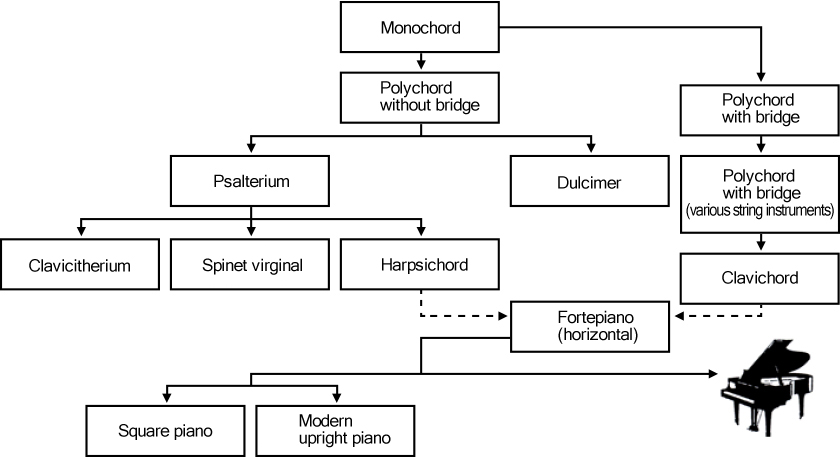
The dulcimer led to the creation of the clavichord, which first appeared in the 14th century. The clavichord has a similar structure to the dulcimer, but unlike the dulcimer, it has a keyboard that triggers small metal blades (called tangents) to strike the strings. Because Clavichords were not loud enough for larger performances, they were mostly used as practice instruments.
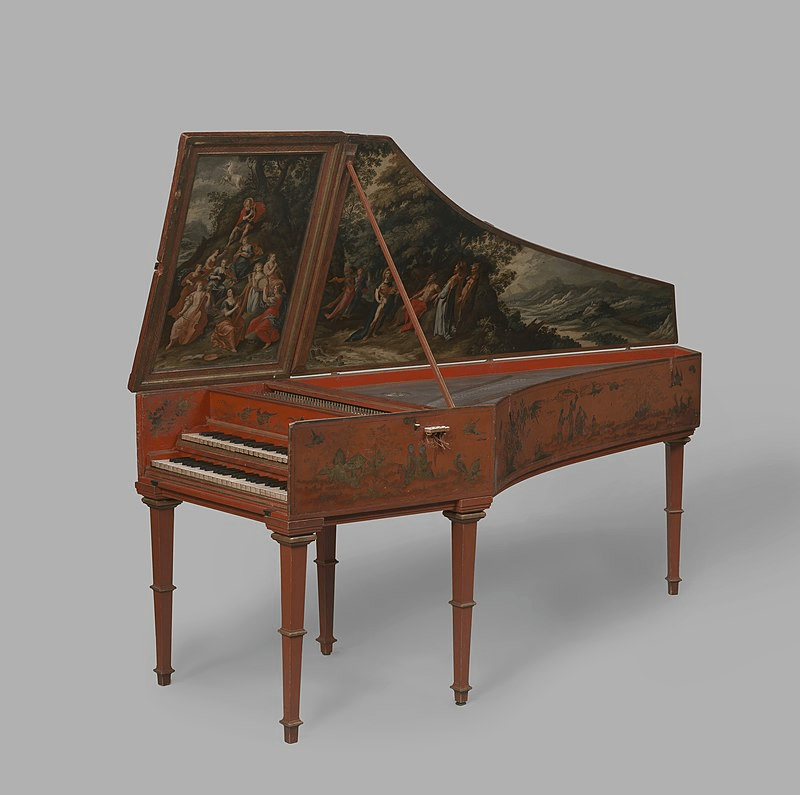
The harpsichord also uses a keyboard, and pressing its keys activates a row of jacks that lift to pluck individual strings with a small pick usually made from quill or plastic. Even though the harpsichord is louder than the clavichord, its sound can not be varied. Being created in Italy in sound 1500, the harpsichord then spread to France, Great Britain and Flanders. The overall structure of the harpsichord resembles very much to the piano.
Finally, we have the creation of the Piano. To begin, the piano was invented by Bartolomeo Cristofori (1655-1731) in Italy. Cristofori was unsatisfied with the lack of volume control when musicians would play the harpsichord. He decided to replace the plucking mechanism with a hammer to create the modern piano in around 1700. This amazing instrument was first named the “clavicembalo col piano e forte”. (A harpsichord that can play soft and loud noises.) This was later shortened to the common name, “piano”.
The evolution of piano traces its origins from early string instruments such as the dulcimer, which used hammers to strike the strings, and ended with the Fortepiano which uses the same mechanism but in a more elaborate way. The piano’s most special feature is probably the fact that it can play multiple “voices” at a time. (“Voices” means different sounds) Other instruments such as the flute or the violin are only capable of playing one sound at a time. However, this prestigious instrument only was to be made recently, but to get to it, it took hundreds of years.




 lilagazette.com
Leave a comment