
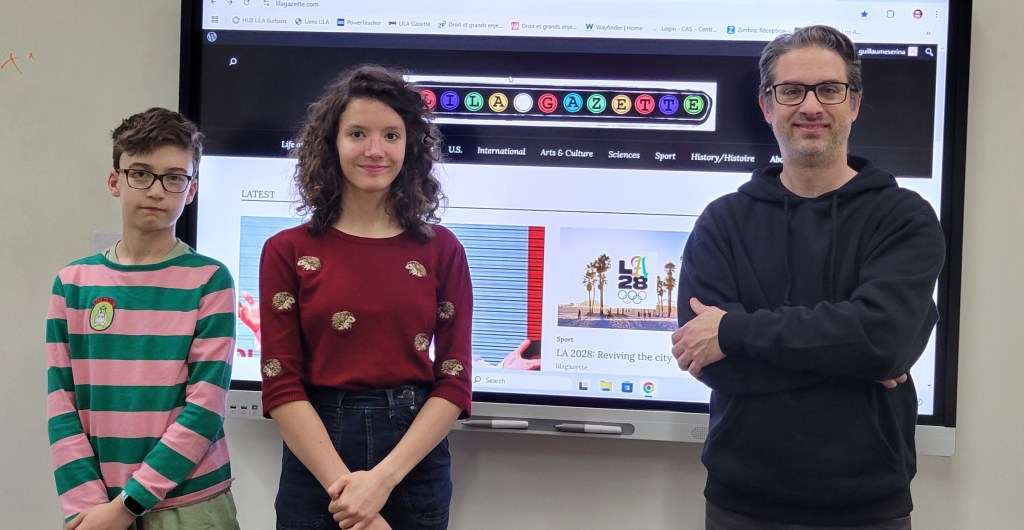
LILA Gazette journalists, Belén Haberman and Malachi Newman interview our newspaper’s editor about his career and the importance of our journalism club.
Why did you decide to become a teacher? What classes do you teach?
I’ve been teaching at LILA for five years. I teach History-Geography in 8th grade and 10th grade, I teach Knowledge of the World in 11th and 12th grade, as well as an introduction to Law in 12th grade. I also run the LILA Gazette with a great team of young journalists.
I went into teaching after being a reporter for 20 years. I decided to stop journalism on a daily basis, but I still write on the side. Education has always been in the back of my mind and since I’ve had degrees in History and I was a historian at the early age of my journalism career, it was a logical decision for me.
Have you taught at a school before LILA?
This is my first school that I’ve taught at.
We know that you were a journalist before you started teaching at LILA. When did you decide to become a journalist?
From a pretty early age. I got interested in journalism when I was 12 or 13. I loved watching the news and reading the newspaper. I also loved, as a kid, reading the adventures of “Tintin”, who is a reporter. So, the idea of traveling the world and meeting people from different backgrounds was interesting to me.
Could you talk to us about your work as a journalist? Did you have to travel frequently? If so, which countries have you been to?
I started my career in France. I was based in Paris and I also worked in TV productions for news magazines on public television. So most of my work was in France although I also got to do some reporting in Spain, Denmark, and the UK. I also started covering US news, traveling in America from Paris. After about ten years, I decided to move to Los Angeles, and there for the next 12 years I worked as a US correspondent for French media. This means I was covering what was happening in the United States for French speaking media from France, Belgium, and Switzerland. Whatever happened in the US, I had to report, whether it was fires in Los Angeles, the Great Recession, presidential campaigns, the entertainment industry in LA, or the environment.
Why does journalism inspire you? What were your favorite subjects to write about?
My passion has always been US politics. Actually, since being an adolescent, I was watching American politics. US History and the Political System was my degree from the Sorbonne in France. I was really excited to cover Barack Obama’s campaign from before he announced running for president. I was lucky to cover all of that, to write a book about him, and to sell my stories to my clients in France. But overall what’s really interesting is to go from one topic to another. Let’s say one day you’re in a campaign rally event in the Midwest and the next day you can be in Washington D.C. interviewing a US senator, and then the next day being with homeless people in Skid Row, Los Angeles and then the week later interview a famous actor. This diversity of topics made journalism really rich for me, rich on a human level, emotional level, and intellectual level.
Why did you decide to take charge of the LILA Gazette? Why is the LILA Gazette important to you?
I wanted to reboot it. It already existed at LIlA for a long time. It was a small formatted paper, but we didn’t have any regular publications, dates and a rhythm. Also we had a lot of fiction, which is a good thing and we do have it now in our current Gazette, but I think it was really important to turn it into a real journalism club. Why? We are in a world where finding good sources and quality information is difficult. Where the industry is suffering a lot and we have many layoffs in traditional media. You also have the competition with social media, where people think they act as journalists but they are not properly trained. They don’t have the skills to verify, double check, triple check. So for us at LILA with Mrs. Harvey and Mr. Mondange, we decided to reboot the Gazette into a true journalistic paper. We felt it was important that in Middle and High school we would start to train young journalists like you to do professional journalism. Of course, we don’t take ourselves too seriously, but in order to start fighting fake news, students need to learn how to complete their work and then hopefully our readers will enjoy what we write and what we do, and also say “hey, this is good quality” or, “ they did a good job”. That is what I think is really important.
Could you tell us a little about your book An Impossible Dream. Reagan, Gorbachev and a World Without the Bomb?
That was quite an adventure actually. The work took about 3 years from start to end, meaning starting to research, trying to find people to interview and all the way to the end of the writing. I started this nonfiction book in 2013 and it was published in France and French-speaking countries first in late 2016. Then it got translated into English and came out here in the US in 2019. So writing a book is a long process. I’ve always been interested in the Cold War. I witnessed on my TV the end of the Cold War. That’s what I wanted to research as a historian. Here in Los Angeles, we have two presidential libraries: the Nixon Library and the Reagan Library. These are not just museums, they are the locations of all of their presidential archives. So, I was lucky to be able to study there for one year. Once a week I was going to the Reagan Library and working with archivists to find the right sources. The work of a historian is where you have to collect several sources, you have to recoup them, double check them… I did the same with Soviet archives that are now all available in English. I also interviewed witnesses from that time because the story is about the 1986 summit in Reykjavík where Reagan and Gorbachev met for two days and how they tried to get rid of all of the nuclear weapons but failed to succeed due to a single detail. That is the suspense there, so it’s a true story, nothing is invented. I also met and interviewed Russian and American advisors. I was lucky enough to go to Moscow to meet with Mr. Gorbachev and to interview him in 2015. That was wonderful. After he read it, he agreed to write the introduction for the English version of the book.


 lilagazette.com
Leave a comment