
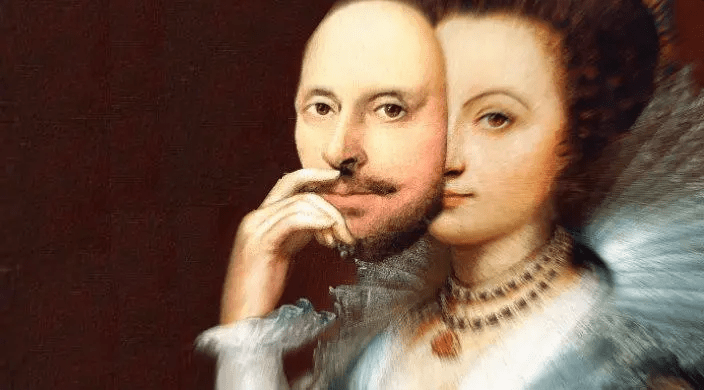
William Shakespeare is arguably the most famous and influential playwright of all time – but did he fully write his own work? There are a few people who might have been authors, but only one is a woman.
By Ella Erez – 11th grade.
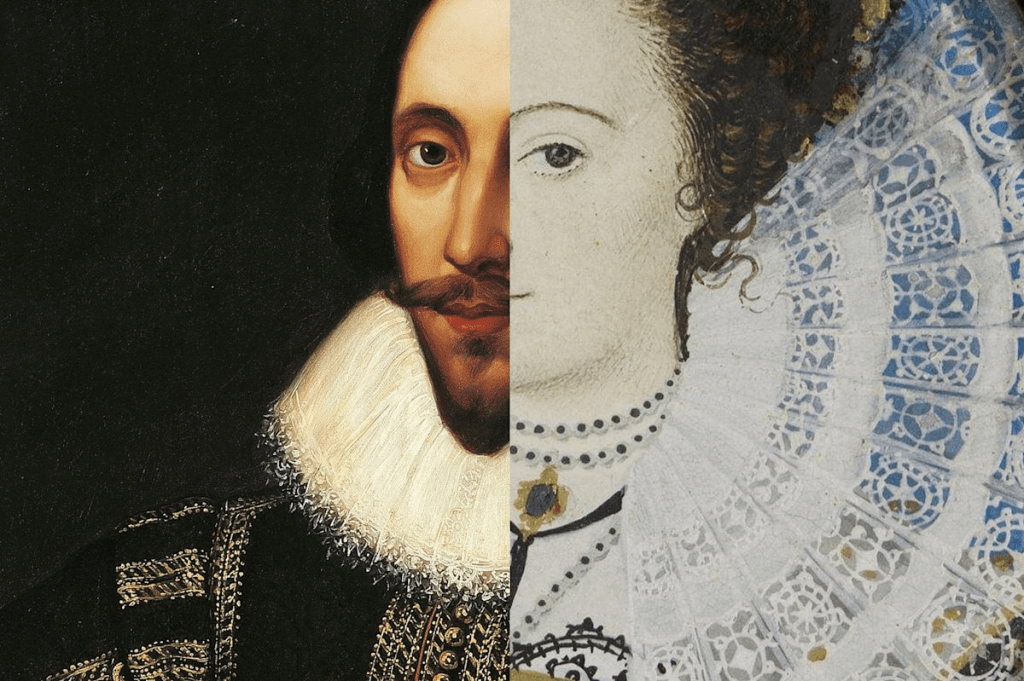
There are countless theories surrounding Shakespeare’s authorship, questioning if he truly wrote all of his plays. Many historians ask whether a single man was capable of writing all of them, and several biographical facts about his life don’t match up with historical facts about the plays. To others, these claims sound like conspiracy theories. We know for sure that William Shakespeare existed, but he could have been a frontman for another person’s work. The most shocking theory of all may be that a woman was behind Shakespeare’s world famous plays. For decades, historians believed that it could’ve been at least one or two men, or a bigger group of male playwrights who wrote the most famous plays of all time. However, the only woman on the list of possible authors is someone rarely talked about: Emilia Bassano.
Emilia was an English woman from an Italian family of court musicians, meaning that they played music to entertain the queen and her court. She was also Jewish, which she practiced in secret for her safety because of prolific antisemitism in Europe at the time. Emilia was educated, which was rare for a girl of her age in sixteenth century England. After her father’s death when she was seven years old, she went to live with Susan Bertie, the Countess of Kent. It was there that she was tutored in various subjects. Emilia’s mother died not long after the former’s eighteenth birthday, and Emilia became the mistress of Henry Carey, the Baron of Hunsdon, who was forty-five years her senior. She received a pension of £40 a year, which would be equivalent to approximately £16,000 today. Emilia had stayed with him until she was twenty-three, when she became pregnant with his child. She was quickly married to her cousin, Alfonso Lanier, and gave birth to two children: Henry and Odillya. Odillya died soon after her birth, at ten months old. In 1611, Emilia became the first ever woman in England to publish a volume of poetry, titled Salve Deus Rex Judaeorum. She died in 1645 at the age of 76.
Trip to Denmark
When Emilia was twelve, the Countess of Kent got married, so Emilia wasn’t able to live with her anymore. Instead, she moved in with Susan’s brother, Peregrine Bertie, who was the English ambassador to Denmark. In 1582, he went on a trip to Denmark to meet Frederick II. He took Emilia with him. Hamlet, Shakespeare’s longest play, is set in Elsinore Castle in Denmark. Hamlet’s two close friends in the play are called Rosencrantz and Guildenstern, names which were based on real Danish nobles in the court at the time that Emilia and Peregrine visited. However, there is no evidence that Shakespeare ever traveled outside of England, and took most of his information from books. Emilia would have been there to be able to describe the fictional Elsinore Castle, which is based on Kronborg Castle, and to use Rosencrantz and Guildenstern’s names. Similarly, The Merchant Of Venice contains surprisingly accurate descriptions of the canals in Venice where Shakespeare had never been but Emilia had since her family was Italian.
Perhaps the strongest argument leading to the conclusion that Emilia Bassano is a contender for Shakespeare’s authorship is that she was the mistress of Henry Carey, who was the Lord Chamberlain. This position meant that he oversaw all theater productions in England and was put in charge of the theaters themselves. He was also patron of the Lord’s Men, the theater company that published Shakespeare’s plays. If Emilia was the writer behind his works, it would have been convenient for her to be in a relationship with someone who was in charge of the nation’s theater so she could publish work through him while staying anonymous.
Portia disguised as a man
Plays such as Much Ado About Nothing feature strong female leads like Beatrice. She is meant to be witty, sharp-tongued, dominant and very independent from men for a woman of that time. In The Merchant of Venice, Portia is the same. She is cunning and capable, and even disguises herself as a man to pose as a lawyer in a courtroom where she manages to save the main character’s life. It seems that Shakespeare was fond of these kinds of female characters, but in real life, it’s thought that he possibly didn’t even educate his own daughters, Susanna and Judith. Why would he make characters such as Beatrice and Portia leading ladies in their stories, but refuse to school his daughters? Furthermore, there are characters in Shakespeare’s plays that have names which could have been derived from Emilia’s life. Examples include Baptista in The Taming Of The Shrew, who had the same name as Emilia’s late father; Alfonso in The Tempest, who had the same name as Emilia’s husband, and Emilia in Othello.
The Merchant of Venice is also known for its antisemitic stereotypes which manifest in Shylock, a Jewish moneylender who uses his conniving and manipulative wit to trap the protagonist, Antonio. The book was banned in many schools and communities due to its caricature-like portrayal of Shylock. This was considered normal at the time since most people in England were antisemitic. It seems unlikely that Emilia would write about Shylock in this way since she herself was a hidden Jew, but in the courtroom scene at the end of the play, Shylock pleads for basic human rights: “Hath not a Jew eyes? Hath not a Jew organs, dimensions, senses, affections, passions?… If you prick us, do we not bleed?… If you poison us, do we not die?” (Shakespeare, Act III scene I) Shylock is humanized despite being the villain in the story, and asks those around him to consider that Jews are just as much human as everybody else. This would seem controversial for Shakespeare, but if Emilia wrote it, it could’ve been her way to make readers sympathize with a character they would be taught to hate because he’s Jewish. In fact, she may have set Shylock up to be a villain only for the final monologue to be more cathartic.
Bisexuality
Finally, there are many theories surrounding Shakespeare’s sexuality, and it is generally accepted that he could’ve been bisexual. 126 of Shakespeare’s sonnets seem to be addressed to a man who was younger than him called ‘Fair Lord’ or ‘Fair Youth.’ Historians think that this man was Henry Wriothesley, the Earl of Southampton. Though it’s possible that Shakespeare did have affairs with men, another explanation would be Emilia Bassano’s affair. Historical records suggest that she had an affair with Henry Wriothesley as well, who was four years younger than her. At the time of their relationship, she was believed to be about 24 while he would have been 20.
Though Emilia Bassano, along with other possible “real” authors such as Christopher Marlowe, hasn’t been accepted as the person behind Shakespeare’s plays because of a lack of evidence, it doesn’t mean that we shouldn’t question the authorship. If it turned out that she was the true author, she would’ve been a trailblazer for women and Jewish people at the time who faced discrimination and who couldn’t publish their creative works. She already became an influential figure by being the first woman in England to publish a poetry collection. Whether or not Emilia was the true author, her story remains a powerful reminder to reexamine literary history and the role of women in shaping it.




 lilagazette.com
Leave a comment