
Scrolls damaged by the eruption of Mount Vesuvius in 79 AD have long been indecipherable for historians, but new technologies are helping solve this problem. Thanks to artificial intelligence, researchers are now able to read what was long considered unreadable.
By Amandine Galama – 12th grade.

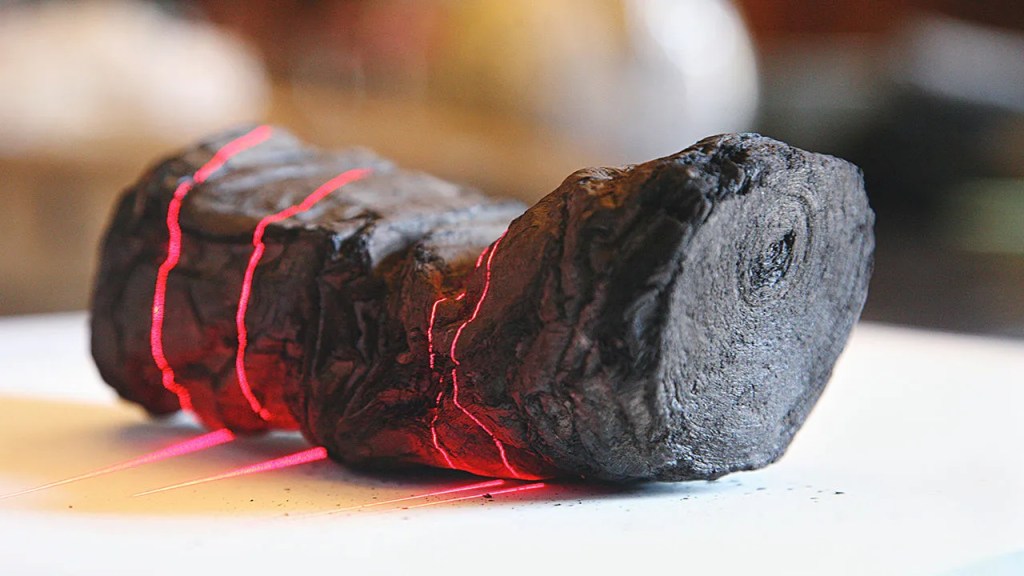
The scrolls excavated from a Roman villa near Pompeii in the 18th century were illegible up till now, having been burnt and damaged by the heat from the eruption of Mount Vesuvius. The scrolls were too fragile to physically unroll, making them impossible to read. However, computer scientist Brent Seales of the University of Kentucky, has shown that physically handling the scrolls is not necessary to read them. The scrolls can be read through CT scans and machine learning algorithms trained to detect ink.
This discovery led to the creation of the Vesuvius Challenge, a competition with prizes for the team that deciphers the most text from scans of scroll fragments. The winning team of the challenge was able to read more than 2,000 letters after developing an algorithm that automatically unwrapped the CT scans. This text talks about sources of pleasure, such as food and music. This technique has also now been used on other scrolls, including one that is believed to reveal where Plato is buried.
Machine learning algorithms are helpful for historians in other ways as well. A historian’s research can be very time consuming, because they must analyze many documents in detail. The digitization of an increasing number of historical documents has provided easy access to tons of useful information, but also created an excess of information that is difficult to sift through. Therefore, machine learning algorithms have been developed to speed up the process. They are able to find important information much faster than a human could. In addition, thanks to the large quantity of information available to these algorithms, they can create connections between documents that historians, limited to analyzing one thing at a time, cannot. These algorithms are also often capable of identifying patterns that people do not detect, providing us with a new insight into the past.
Archeology is also seeing an increase in the use of artificial intelligence, notably for locating sites of interest. Traditionally, this work is done by using ground surveys to detect these sites. In recent years, satellite photos have also been helpful. However, these methods are time consuming, and difficult to use when searching large areas such as a desert, where sand and dust storms often obscure the ground in the images. This is why, a team of researchers at Khalifa University in Abu Dhabi, developed a machine learning algorithm trained to identify potential archeological sites in the desert around Dubai, using synthetic aperture radar (SAR), a satellite imagery technique. Not only is the technology very precise, it is also able to create models of the expected structure, giving researchers an idea of what they will find.
When it comes to understanding ancient languages, or dialects that are no longer spoken, machine learning, particularly deep learning networks (neural networks that more closely mimic the human brain), can be useful. Deciphering ancient languages is a difficult task. There is often very limited data available for ancient languages, do to limited surviving records, and different transmission traditions. Additionally, different writing systems were in use, some of which are no longer used, and some of which have still not been deciphered, such as the Indus script. Language idiosyncrasies, like abbreviations, can make a text hard to read as well, and a text could even be written in multiple languages. Another difficulty when it comes to decoding these texts, is that only a small number of this data has been digitized. Languages evolve over time, and can vary by region, so to translate an ancient text, it is essential to identify the place and time of writing. One such neural network is Ithaca. It is the first neural network to aid historians not only with the restoring of missing parts in damaged inscriptions, but also with identifying the date and location they were written in.
However, not everyone is happy with the use of artificial intelligence in historical research. AI can provide new insights and information about history, but it also brings its own problems. AI is known to be biased, since it was created by humans, who are biased, which presents the risk of it coming to biased or false conclusions. One way in which artificial intelligence may struggle when analyzing the past, is that most AI models are trained on data sets from the past 15 years. This means that when it comes to analyzing photos, AI models are trained to recognize contemporary objects, but may struggle to recognize past iterations of these objects. For example, an AI model able to identify an iPhone, may not recognize that a switchboard is for the same purpose. This begs the question of how reliable are machine learning algorithms when it comes to providing this information, and how can we minimize these biases?



 lilagazette.com
Leave a comment