
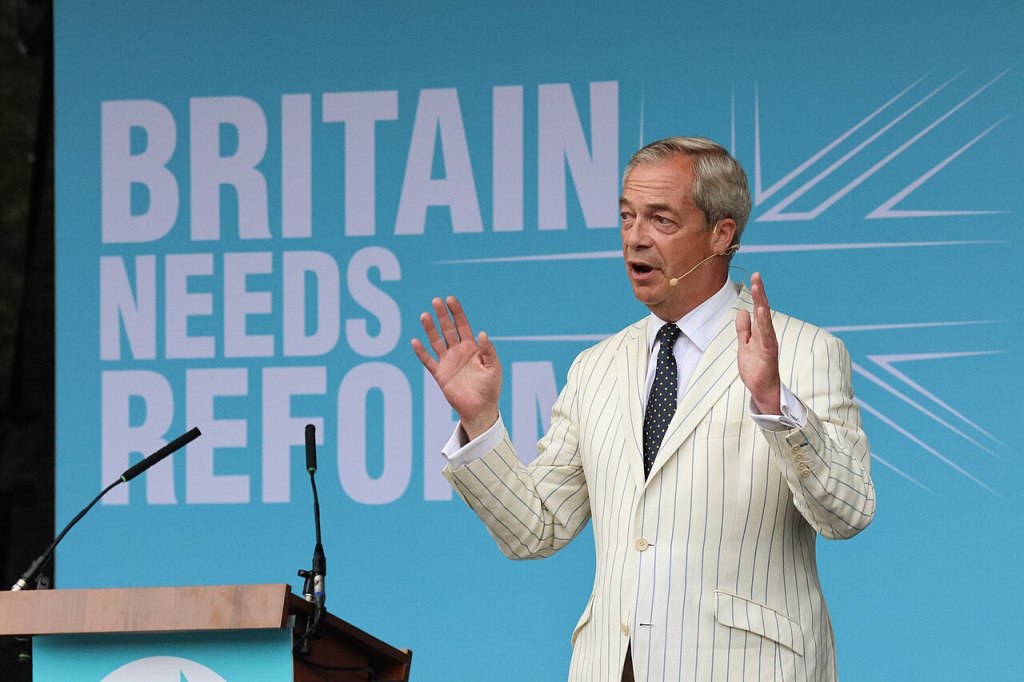
The head of Britain’s most right wing party is a name seen ever more in British papers. Despite their short history in politics, Reform and Farage are becoming ever more important as halfway into his second year Starmer’s approval rate is still struggling.
By Tara Rennie – 9th grade.
The 2024 UK election, the Conservatives (or Tories) are out, Labour is in and everyone was talking about right-wing populist party Reform UK and its leader Nigel Farage. For the first time, Farage and his party have gained seats in the Commons, allowing them to impact British legislation and the government. Despite only having 5 seats (due to the first-across-the-post-in-small-constituencies nature of British elections), Reform currently has more public support than any other party. While this may not seem all that important at first, not since 1906 has a party other than Labour or the Tories won the most seats in parliament, and based on the last two years Reform could be the first to break the mold.
So how did this party come about? Reform UK was started in 2018 by Nigel Farage and Catherine Blaiklock, under the name of “the Brexit Party”, before changing its name to Reform UK in 2021. The party quickly became successful, winning more Members of the European Parliament than any other UK party in 2019, establishing Farage as a political leader.
Farage himself was born in 1964 in Kent, and attended Dulwich College, a private high school, before going into the metal exchange industry at 18. Originally, he was part of the UK Independence Party, and served in the European Parliament from 1999 until Brexit in 2020, establishing his own party in 2018 and serving for them as an MEP for one year (until Brexit). Up until 2024, Farage owned the majority of Reform’s shares, with the party having been established as a private limited company, unlike most political parties. Farage briefly left Reform in 2021, handing the party over to Richard Tice who had been involved in the party since its Brexit Party days. However, Farage retook the reigns in mid-2024, spurring the party on to victory. After Reform’s 2024 success, Farage gave up ownership of the party. He remained as party leader, but members were now able to vote on policy motions for the first time and create a constitution for the party. This came at the same time as 12,000 new members joined Reform, solidifying it as a party that could easily overtake the Tories on the right.
Farage has distinguished himself from the Conservatives (that have represented the right wing in the UK for decades) by portraying Reform as a further right populist party, taking harsh stances on issues like migration. Similar to the US, Farage wishes to massively increase deportation rates in the UK, as well as further distance the country from the EU and other foreign powers. In line with traditional right-wing politics, Farage wants to remove inheritance tax for estates under £2 million, decrease the tax on small businesses and up the threshold where you begin paying income tax. On almost all right-wing issues, Reform has taken an extremer stance than the Conservatives, portraying themselves as a tougher version who “will get stuff done”.
A Reform government with Nigel Farage as Prime Minister in 2029 is a growing possibility. Many Britons are unhappy with the way Starmer has run the country in the past year, and the controversies surrounding Mandelson’s appointment and Ollie Robbinson have done little to boost his approval. The Conservatives are not faring much better, with Tory support dropping to its lowest in 24 years in mid-2025. The election, however, is still years away, so why talk about Farage?
Simply put, the next few years will, along with Reform’s history, showcase what a Reform government would look like. With Farage’s first time in the Commons, he is now able to shape, at least somewhat, the course of the country. For a party with only five seats, Reform has more support than any other party, indicating the power Farage holds. Now, Farage’s take on all major stories and policies are in every paper. This makes an understanding of Reform even more pressing as Britons are turning to the party out of anger rather than genuine agreement.

Moreover, Reform success ties heavily in with the Green party, the furthest left in the UK. Having recently won a byelection in a constituency that was solidly Labour for decades, the left’s turn towards the Greens and the right’s turn towards Reform is resulting in a more polarised society. This shift can be seen across the globe, as fewer people are willing to reach across the aisle or vote moderately. Of course, none of this means Reform is certain to win, and nobody can predict what the future may hold. However, it is undeniable that Farage is now and will remain until the next election a pivotal figure in British politics, as Britons stray from their traditional party lines.
Watching Reform for the next few years will provide an insight to Britain’s political landscape in the decade to come. Often compared to a British Trump with many overlapping policies, the 2029 election could see Britain taken down a similar path the year after Trump’s second term ends, with Reform already beginning to polarise the country. Additionally, Reform in power would have long reaching impacts across the globe, likely further isolating the UK from its allies and especially the EU, once again, similar to Trump. In the end, however, a Reform UK government is far from certain, with Farage’s Cameos showing his radicalisation sooner than that the British radicalized. Watching how the far right policies play out in the US could still impact Britain’s trust in Reform and who knows, maybe Starmer will miraculously gain public support. At the end of the day though, Reform and Farage have been established as major players in British politics, possibly shaping both the country and Britain’s foreign relations in the years to come.
Despite only gaining 5 members of parliament, Reform won 14.3% of the popular vote, only 9% behind the Conservatives, the previous governing party. As the British election system works by the majority vote individually in 650 constituencies (each electing 1 MP), Labour won 33.7% of the popular vote, but received 63.2% of the MPs in what was known as the “loveless landslide”. Importantly, Reform came second in 98 constituencies, 89 of which were won by Labour, suggesting that they are already replacing the Tories as the leading right-wing party.
The following year, local elections were held in 23 of England’s councils. Reform won 41% of the seats up for election, a clear signal from the British public of the lack of trust in both Labour and the Tories, as well as a shift to the right. Many political analysts and the majority of the polls now state that the UK will vote Reform into office in 2029, with as much as 35% of the country already supporting the party.
Currently, the UK still has what is widely recognised as a two party system, as the political landscape is largely shaped by the right-wing Conservatives and left-wing Labour. The Liberal Democrats have for years been the ‘third-party’, even sometimes forming a coalition with Labour but never governing solo or winning the majority. However, (as this article is about it), this is beginning to change. Now there are five parties spoken about, the three traditional ones, Reform and the Greens. Should Reform win in 2029, it could break the power balance within British politics, upending the two party system. For better or worse, this undoubtedly would shift the political landscape, and force the Conservatives and Labour to reevaluate their support.



Leave a Reply