
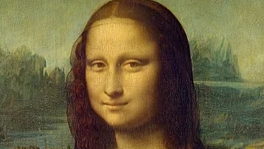
Have you ever wondered why the Mona Lisa is consistently attacked? Get ready to jump into her story, and learn more about her five most maniacal encounters, in addition to unbelievable stories people have to tell as excuses to their vandalisms.
By Paisley Schubert – 9th grade.
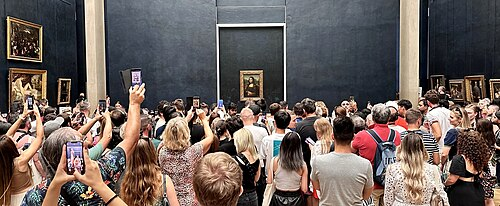
Her haunting, unsettling smile gracefully sits in the presence of an ominous setting: a hazy veil clouds behind the woman, leaving her engulfed in darkness. Her mood, so melancholic yet joyous leaves the audience questioning her mysterious character. The skeletal trees hang over the corners of the painting, adding an even more nostalgic feel to her gripping humour. Somehow, tourists are affected by her, attracted, fascinated, to a point where it may drive them insane. Some may throw soup at her, vandalize, smudge cake or even spray paint the chef-d’oeuvre. It would appear that the Joconde is attacked due to her popularity, and that it attracts attention to the tourists admiring the painting. Since Da Vinci’s masterpiece is so historical and cultural, many people tend to ambush it, making it an impactful event. To understand the various vandalisms and mysterious history of the Mona Lisa, let’s dive into her story.
Intriguing History & Major Attacks
Leonardo Da Vinci’s painting the Mona Lisa is widely famous for her puzzling aspects: nobody knows who she was, if the painting was a self reflection of Da Vinci himself, why her smile seems so peculiar, and why the landscape drawn is so bizarre. However, according to most sources, Mona Lisa would be the wife of a Florentine merchant Franceso di Bartolomeo di Zanobi del Giocondo, and named Lisa Del Giocondo, “Giocondo,” giving the painting its French name “La Joconde”.
The painting was presumably created between 1503-1519. The artwork became widely known because it came across several journeys: fascinatingly, soon after the artwork was completed, the Mona Lisa arrived in France. François Ier, the French king who fought battles in Italy, was fascinated by the Italian Renaissance. He officially invited Da Vinci to settle in France. The artist moved to the Val de Loire region, where he died in the “Château du Clos Lucé,” in Amboise. The Mona Lisa is a gift from Leonardo to France. After the king’s death, the Joconde remained in France, later to be given to a French emperor, Napoléon Bonaparte, where he hung it up in his bedroom wall in the Tuileries Palace. Following this, the painting witnessed a remarkable sequence of historical occurrences, each contributing to its reputation and the crowd surrounding it.
In 1911, Italian painter and former Louvre employee Vincenzo Perrugia decided that the painting had to return to its “birthplace” in Italy, because it was “stolen” from where it was originally illustrated. So, he cut the canvas from the frame, rolled it, hid it in his Parisian flat, and brought it to his hometown, in Florence. Perrugia sought to sell it to an art dealer, but the art specialist recognized the masterpiece and called the police on the robber. After this attack, the Mona Lisa was brought back to the museum, the Louvre, where it really belonged. Surprisingly, this event was the first theft the remarkable painting has ever experienced, which would soon lead to more risky, terrifying, and perilous attacks afterwards…
45 years after her previous assault, the Mona Lisa was hanging on the wall, smiling at her visitors, only to wait until her next raid.
In 1956, the staff working at the Louvre brought the masterpiece away from her resting place to go on a temporary tour in a museum in Montauban, situated in the South-West of France. During this trip, a strange and unknown vandal stood facing the painting, and doused the lower half of it in acid. Shockingly, no one knows who the wrecker was, however we do know that they were a woman. After this episode, the Louvre installed a glass casing to protect the artwork, hoping it wouldn’t be targeted again.

The Joconde was targeted the same year in December, when a homeless Bolivian man powerfully threw a rock at the painting, lightly shattering the glass, and chipping off parts of her elbow. Moreover, the reason behind this action is sad: Unzaga vandalized the masterpiece hoping to get recognized by the police, because the beds in jail would be more comfortable than sleeping on the streets.
In April, 1974, the Joconde was taken away from her homeplace a second time to be temporarily showcased in the Tokyo National Museum in Japan. Locals were thrilled regarding this news; people were crowding the streets, clogging lineups, peaking over visitors to get a better view of the masterpiece. Due to this chaos, a woman on a wheelchair attempted to get closer to the painting, hoping to spray it with paint. The reason behind this attack was to protest against the fact that it was unjust that people with disabilities such as herself weren’t able to access a closer view of the artwork. Luckily, the spraypaint didn’t reach the Mona Lisa, given that it was protected with glass casing.
Despite these incredibly infamous events, the Joconde experienced another assault, one that had only taken place four years ago.

On May 29, 2022, a 36 year old male climate protester disguised himself as an old, disabled woman in a wheelchair, in order to get a closer glance at the painting. Suddenly, as he inched closer to the Mona Lisa, he lifted a piece of cake from his hand, and smeared the spongy sweet all over the casing and tossed roses into the crowd. The man in disguise rose from his wheelchair and screamed: “There are people who are destroying the Earth, think about it. All artists tell you to think about the Earth, all artists think about the Earth, that’s why I did this. Think about the planet.” The protester was dragged away and detained, to be soon sent into a psychiatric unit. Protesters target the picture because of its paint: it contains oil.
All in all, the Mona Lisa, created by the famous painter, Leonardo Da Vinci during the Italian Renaissance, has come across many experiences which have molded her status, changing her place in society. Attacks have affected her physical appearance, changing both the way she looks and the perspective visitors have on her. From castles to glass casings to being smudged with cake, the masterpiece has lived through history, evolving over the span of time. Hopefully, she doesn’t have other ambushes, but she still stands in the country where she was gifted, calmly smiling down at her admirers.





Leave a Reply